
📊 The Problem#
Domain-specific transformer tasks — legal document classification, medical text analysis, niche technical categorization — routinely run into the same wall: not enough labeled data, and manual annotation costs scale linearly with volume you don't have budget for. The obvious automated fix, having a single LLM label everything, trades one problem for another: a single model's biases and blind spots become systematic errors baked into the whole labeled dataset with nothing to catch them.
The organization's own documents would have made the best training templates, but they're full of PII that can't leave a controlled pipeline.
🚀 The Decision#
Instead of one LLM doing the labeling, I built a multi-LLM ensemble — GPT, Claude, and Gemini, each with model-aware prompts tuned to that model's specific strengths, cross-validated against each other so disagreements surface instead of silently becoming label noise. That's more expensive per label than a single-model pass, but it's what makes automated labeling trustworthy enough to actually replace manual annotation rather than just supplementing it.
For the PII problem, I didn't choose between "use real org data" and "use synthetic data" — I built a template system: real organizational documents provide structure and realistic context, but PII gets masked and replaced with dummy data before anything touches a model. That preserved the domain realism that makes training data useful while keeping sensitive information out of the pipeline entirely.
🏗️ How It Was Built#
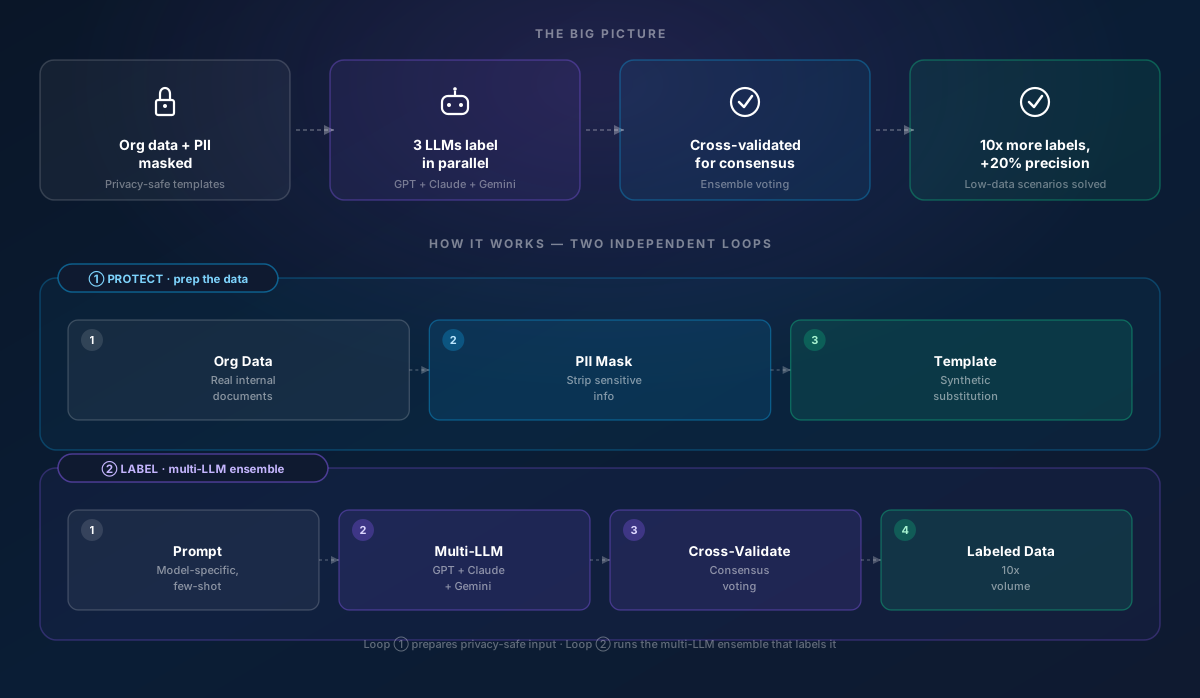
Two loops:
Protect. Organizational documents get PII-masked and synthetic data substituted in, preserving document structure and context while stripping anything sensitive — this runs before any document reaches an LLM.
Label. Model-specific, few-shot prompts (with chain-of-thought reasoning for explainability) go to GPT, Claude, and Gemini in parallel. Outputs are cross-validated for consensus — disagreements get flagged rather than averaged away — producing the final labeled dataset.
📈 Impact & Results#
- 10x more labeled data than manual annotation, at roughly 80% lower annotation cost
- 20% precision gain in low-data scenarios, 35% better label quality from the cross-validated ensemble vs. single-model labeling
- Zero PII exposure across the entire pipeline, via the template-and-mask system rather than a blanket restriction on using real organizational data
This work has been presented at academic conferences and adopted by other research teams working on similar weak-supervision problems.
Key Achievements
10x more labeled data via multi-LLM ensemble
20% precision gain in low-data scenarios
35% better label quality, prompt engineering
Automated label assignment using OpenAI GPT, Claude, and Gemini with comprehensive PII masking, chain-of-thought reasoning, and model-specific optimization